|
|
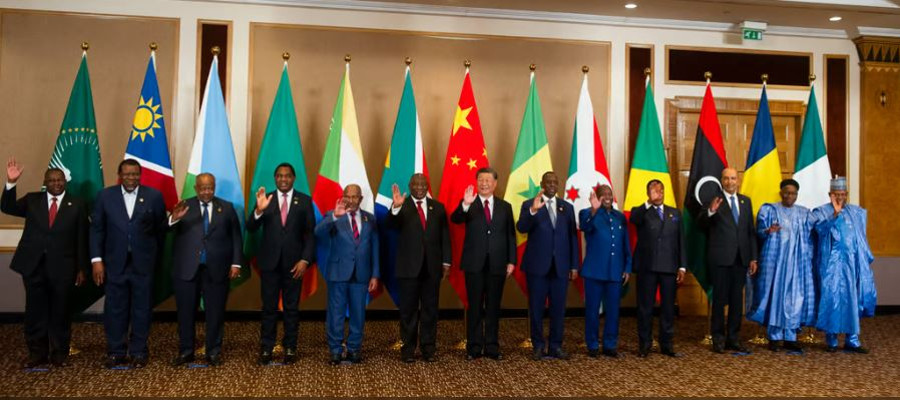
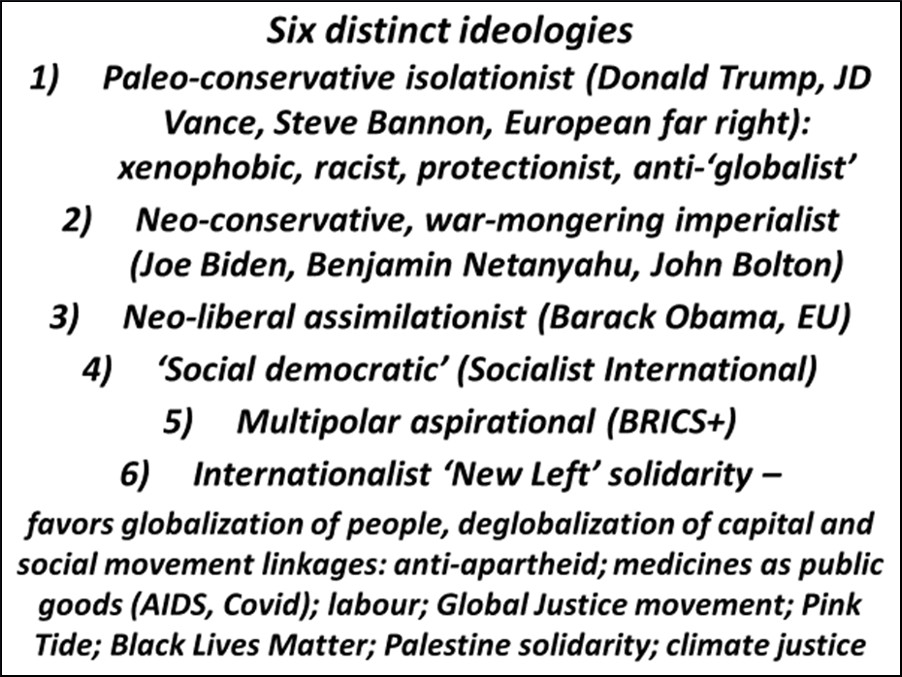
Rising dangers of imperial+sub-imperial partnering It is vital to recognize the rising dangers associated with these deals, which at least since 2009 have reinforced status quo finance, climate-management and political relations and in many cases amplified the worst aspects of predatory global capitalism. The logic of durable imperial territorial expansion The partnership “between a rider and a horse” was the way white-supremacist Rhodesian leader Godfrey Huggins described the neo-colonial arrangements he foresaw in managing racist rule (from 1933-53), in what later became Zimbabwe (cited in Arnold 2005, 383). A similar partnership exists between the wealthiest Western economies and ‘middle powers’ (or ‘emerging economies,’ depending upon who spouts the jargon), in spite of a widespread claim that from below, a new mood of ‘multipolarity’ is currently in the process of replacing Washington-dominated, imperialist unipolarity. Like Huggins’ effort to forestall black majority rule, the divide-and-conquer partnership strategy is likely to prevail for many years, in spite of extreme geopolitical tensions, the fast-worsening climate and biodiversity catastrophes, more pandemic threats, vicious inequality which appears to be fueling the far right’s rise, and a combination of financial volatility and systemic overproduction that cannot be cured. In this context, the G7 economic core powers need to forge partnerships with the leading layer of emerging powers, and in venues such as the G20, Western elites do appear to be succeeding. But this process unfolds to the detriment of all but the upper layers of G20 societies, at the risk of planetary destruction, given how successfully the ruling-class partnerships have prevented the genuine resolution of global-scale crises. The scope for imperialist assimilation during periods of economic and geopolitical stress is enormous but still embodies extreme contradictions, dating to the competitive internecine battles between a few great European powers in the late 19th century. Their internal capitalist-crisis tendencies spurred an unprecedented geographical expansion into colonial territories. The process was facilitated by major financial markets, which in turn ran into various limits, as Rosa Luxemburg (1913) was first to explain in The Accumulation of Capital, thus requiring empire building. World War I was about to break out, because of inter-imperial rivalries that could not be displaced. Still, as early forms of imperialism unfolded and unraveled, Luxemburg documented better than anyone of her era, the articulation of capitalist and non-capitalist relations – as the core characteristic of imperial exploitation – that had emerged to the enormous benefit of the former. Colonial military power was typically deployed to conquer territory and establish formal state management and later, informal neo-colonial political-economic power relations. The policing, legal and monetary systems that capitalism required were established by the colonial regimes to subjugate peoples and to extract resources, dating to the 16th century in the British, French, German, Dutch, Portuguese, Spanish, Belgian and Italian spheres of influence, especially when codified in the 1884-85 Berlin conference that carved up Africa. In our current age, that imperialist formula – capitalist crisis formation in the core, its geographical displacement, facilitative financial institutions, and neo-colonial grabbing of resources and territory – remains highly relevant, albeit with a much stronger middle layer than has heretofore existed. But the main additional element that became more vital after World War II and that has been utterly impossible to avoid since the 1990s, was the economic, socio-cultural, geopolitical and military dominance of the United States. Such dominance has increasingly been exercised through Western-headquartered multilateral institutions whose operations favour the interests of the largest multinational corporations and especially financiers. The obvious policing operation for these firms has been by the Pentagon, State Department and the U.S. security establishment, especially in the form of coups against governments hostile to capital, and the North Atlantic Treaty Organization (NATO). More than 800 U.S. military bases abroad, and nearly $1 trillion in annual military spending, ensure exceptional power (albeit with vulnerabilities such as were witnessed in Vietnam, Afghanistan, Iraq and the current Red Sea maritime route) (Tricontinental Institute 2024). Imperialism through neoliberal multilateralism When it comes to supporting capital accumulation processes, the main imperialist multilaterals include the World Bank and International Monetary Fund (IMF), founded in 1944. The World Trade Organization (WTO) evolved from what was originally the 1948 General Agreement on Tariffs and Trade. The ‘Bretton Woods’ financial institutions and WTO dramatically expanded their scope during the 1980s-90s, in the wake of commercial bank internationalization and the 1979 ‘Volcker Shock’ – the U.S. Federal Reserve’s interest rate increase imposed by Chairman Paul Volcker – that led to the Third World Debt Crisis. Another facilitative financial institution is the Bank for International Settlements, a Swiss-based league of central banks dominated by the U.S., UK, European and Japanese. Increasingly punitive financial regulatory systems emerged especially after the Western attack on Muslim banks following Al Qaeda’s September 2001 attack on New York and Washington, amplified by subsequent economic sanctions against Iran and Russia (the latter backfiring when calls for ‘de-dollarization’ became more earnest). And the Paris-based Financial Action Task Force (2023) imposes ‘grey’ and ‘black’ listing of various regimes that did not cooperate with Interpol on money laundering, drug trafficking and terrorism (Gaviyau and Sibindi 2023). The United States had become the global capitalist hegemon after World War II’s destruction of rivals, strengthening its power after the Cold War ended and, by the early 2000s, fusing its military capacity and corporate interests (often expressed through neo-liberal policies imposed by the Bretton Woods Institutions) with a pro-democracy (ostensibly liberal) rhetoric. The democracy posturing was regularly unveiled as enormously hypocritical, no more so than after Israel’s attacks on Gaza and indeed all Palestinians – with Western ‘Axis of Genocide’ support – got fully underway after October 2023. But the 2007-09 global financial crisis had required major revisions, especially in terms of assimilating the political leaders of G20 emerging economies, at a time when relegitimation and a financial backstop were both needed. Whereas in 2008 this was a difficult task for the neo-conservative George Bush regime, conveniently he was replaced in early 2009 by an internationalist more capable of fusing neo-conservative and neo-liberal ideology: Barack Obama (Bond 2009, Harvey 2010).As a result, the 2010s witnessed new forms of imperial rule, increasingly requiring partnerships with a new set of horses that often do the hardest work, until the point in 2017 when the ‘paleo-conservative’ (i.e. dinosaur-type) Donald Trump replaced Obama. To illustrate with the most difficult, durable multilateral problem – ecocide – an imperial/sub-imperial partnership was initiated by Obama’s team at the United Nations Framework Convention on Climate Change (UNFCCC) from 2009-16 (Bond 2012).
That body generally served the world’s main corporate fossil fuel and industrial interests by delaying imposition of greenhouse gas emissions cuts, by promoting market-related strategies (e.g., emissions trading and offsets) and by relying upon the promise of technical advances to reduce and sequester CO2 (innovations which in turn are typically protected behind WTO Intellectual Property regulations, as was the case with what should have been the most needed public goods of 2020-23: Covid-19 vaccines and treatments) (Papamichail 2023). Imperial partnership with major sub-imperial polluters has been vital to maintain this posture, against demands by poor and vulnerable countries for both emissions cuts and Loss & Damage reparations payments. The partnership process began in 2009 in earnest at the Copenhagen UNFCCC summit when Obama barged into a Bella Convention Centre meeting room to propose a deal with leaders of the Brazil-South Africa-India-China ‘BASIC’ group. In his presidential memoire, Obama (2020, 516) remarked of this meeting,
After commandeering the BASIC leaders’ meeting and threatening to call them out publicly for non-cooperation, Obama (2020, 517) recounted how tough talk impressed one of his aides:
 Contradictions
within imperialism/sub-imperialism
Major shifts in capital accumulation
patterns
are reflected in quite dynamic imperialist/sub-imperialist
arrangements. Since
the 1970s, when capitalist crisis tendencies reemerged, East
Asia became an
attractive investment option for firms facing lower profit
rates in the West.
The globalization of trade, investment and finance
accelerated, spurred by the
advent of petrodollars (oil economy reserves) and
Eurodollars which centralized
money in core Western financial havens.
Then, the U.S./British-led neoliberal
financial deregulation from the early 1980s permitted an
explosive growth in
credit, financial product innovations and speculative
capital. Soaring interest
rates – imposed from Washington
in 1979 to address
U.S. inflation – attracted more of the West’s investable
funds into the financial
circuits of capital. And the European Union economy became a
more coherent,
less fragmented unit of capitalist power, with a single
currency by the early
1990s (Bond 2003).
Correspondingly, the multilateral
institutions’ control functions in relation to debtor
countries mainly served
the interests of multinational corporations and banks,
especially once the
1980s debt crisis transferred policy power to the World Bank
and IMF. This
financial component of imperialism is once again a profound
problem, in the
wake of many countries’ Covid-19 debt encumbrances (Hudson
2023).
In this context, various long-standing
geopolitical pressures and military tensions became more
acute during the
2010s, mostly evident as full-blown wars in Ukraine and the
Middle East at
present, but potentially also in conflict liable to break
out at any time in
Central Asia, the Himalayan Mountains, the South China Sea
and the Korean
peninsula.
These divisions can certainly escalate
quickly, submerging broader mutual interests and creating a
‘camp’ mentality:
the West versus a China/Russia-led so-called ‘multipolar’
alignment, which in
turn have profoundly affected anti-imperialist sensibilities
across the world.
There are increasingly fierce debates between those
favouring BRICS (Fernandes 2023)
and those more skeptical of whether
the bloc either represents an actual challenge to global
corporate power (Bond
2023).
The conflicts have extended to labor
migration, trade and finance, as witnessed by the rise of
xenophobia and
rightwing critiques of ‘globalism.’ These were crystallized
in
rightwing-populist victories in three 2016 elections –
Brexit, Trump and
Duterte (Philippines) – followed by others including Brazil,
Italy, Argentina
and the Netherlands, with France and Germany witnessing
strong far-right
upsurges in 2024.
Underlying the lack of faith in
liberal elite
politics is not only mismanagement of what they concede is a
so-called
‘polycrisis’ unfolding in diverse areas of multilateral
responsibility, but
also the decline of most globalization ratios (especially
trade/GDP) after 2008
resulting in a ‘deglobalization’ or what The
Economist (2019)
terms ‘slowbalization,’ or ‘stall-speed’ growth
according to the 2023 UN
Conference on Trade and Development (UNCTAD) Trade and Development Report.
That latter document confesses
“unequal
benefits from trade integration” which since 2021 have begun
to generate “a new
political economy of trade governance” based on “building
resilient supply
chains, supporting a just energy transition, delivering
decent jobs, tackling
corruption and corporate tax avoidance, and developing a
secure digital
infrastructure” – all of which deprioritize “globalization
in general, trade
liberalization specifically” (UNCTAD
2023, pp.33-34).
In addition to these openly-admitted
flaws in
the system, the U.S.-China trade war starting in 2017 and
the 2022 Russian
invasion of Ukraine reflect further contradictions and
limits within capital’s
geographical expansion. The ebb and flow of
paleo-conservative ideology,
against the neo-conservative imperial agenda, will continue
to disorient
imperialist managers and institutions, as was witnessed
during the Trump regime
(and may be again if he wins the 2024 election).
Many such conflicts – born of internal
capitalist contradictions – are not really inter-imperial in
character, but
reflect a ‘rogue’ character within both sub-imperialism –
from which Vladimir
Putin crossed the line by invading Crimea in 2014 and the
rest of Ukraine in
2022 – and imperialism. As for the latter, recall how the
U.S. Treasury took
extreme measures against Russia’s global financial
integration, kicking Moscow
out of the main bank transaction system (SWIFT) and seizing
several hundred
billion dollars of its carelessly-scattered official and
oligarch assets, from
which interest receipts are being to boost Ukraine’s
treasury, as an initial
stage of war reparations, a form of theft in the war between
hostile brothers
that, frankly, is hard to condemn (Bond
2022).
It is difficult to contemplate
contemporary
imperialism without at least touching on all these dynamics
and mentioning the
institutions undergirding imperial power. Since the era of
Lenin’s imperialism,
the system has evolved into a far more complex network
responsible for managing
global capital’s commodification of everything under the
sun, in part by
displacing its crisis tendencies via more extreme uneven and
combined development.
In order to attack each of these processes, we need deeper
conceptual tools,
especially the idea of ‘sub-imperialism,’ although the term
is very alienating
for Third World nationalists. (The Tricontinental [2024]
analysis of
‘hyper-imperialism’ claims “Objectively,
there is no such thing as sub-imperialism...”)
In the process, that would allow us to
transcend a simplistic anti-imperialist rendition of ‘my
enemy’s enemy is my
friend,’ so often found in the so-called ‘campist’ logic
(Robinson 2023). After
all, Vladimir Putin (2022) himself
made clear on
the eve of the Ukraine invasion how stifling he considered
Lenin’s Bolshevik
legacy of
allowing
ethnic nationalities decentralized power, in this
mafioso-style threat: “You want
decommunization? Very well, this
suits us just fine. But why stop halfway? We
are ready to show what real decommunizations would mean
for Ukraine.”
But in spite of that, an
enemy’s-enemy-is-my-friend sentiment – backing Putin’s
invasion, and claiming
China is the world’s socialist vanguard (Tricontinental
2024) – is still part of the ‘new mood,’ as Vijay Prashad
(2023) terms this orientation to Global South
politics. And such sentiments
are regularly expressed by the leadership of the five
largest centre-left
forces here in South Africa: the Economic Freedom Fighters,
the ‘Radical
Economic Transformation’ faction of the ruling African
National Congress (and
its 2024 manifestation as the MK Party), the Communist
Party, and the two
largest wings of organized labor – the Congress of SA Trade
Unions and the
National Union of Metalworkers of SA. Hence formulations
used to address
imperial/sub-imperial power are increasingly important, for
example in
contesting both Russia’s invasion of Ukraine and the
Israeli-U.S. genocidal
attacks, with a consistent line of analysis.
Systemic
political-economic processes underlying imperialism
Such consistency arises when seeing
imperialism
not through Lenin’s (1916) version of the term, but instead
via Luxemburg’s
(1913) recognition that due to the “ceaseless flow of
capital from one branch
of production to another, and finally in the periodic and
cyclical swings of
reproduction between overproduction and crisis... the
accumulation of capital
is a kind of metabolism between capitalist economy and those
pre-capitalist
methods of production without which it cannot go on and
which, in this light,
it corrodes and assimilates.”
The stress in Luxemburg’s analysis is
how
imperialism follows from capitalist power confronting
society, nature and early
states: “non-capitalist relations provide a fertile soil for
capitalism; more
strictly: capital feeds on the ruins of such relations, and
although this
non-capitalist milieu is indispensable for accumulation, the
latter proceeds at
the cost of this medium nevertheless, by eating it up.”
Lenin
(1913) considered
such arguments to be ‘rubbish’ and he wrote off Luxemburg’s
book as a ‘shocking
muddle.’ But the subsequent century proved that even during
a period of
relatively non-competitive Western imperialism dominated by
a sole military
superpower, more extreme forms of ‘accumulation by
dispossession’ – as David Harvey
(2003) has renamed such capitalist/non-capitalist
thievery – are often the recourse capitalism takes when
needing to temporarily
displace its contradictions.
Casualized labor, welfare-state
austerity,
privatization and the wider reach of the extractive
industries into what Marx
called the ‘free gifts of nature,’ are obvious
manifestations. The latter point
– environmental appropriation as an
accumulation-by-dispossession strategy – is
ever more crucial, given the extent of capitalism’s
destruction of nature not
only through pollution and especially greenhouse gas
emissions, but also within
exploitative global value chains from which poor countries
suffer uncompensated
extraction of non-renewable resources (Brand and Wissen
2018).
Samir
Amin (2010) described too many accounts of
imperialism
that ignore depletion of non-renewable resources in a
scathing manner in his Law of Worldwide Value:
Contradictions
within imperialism/sub-imperialism
Major shifts in capital accumulation
patterns
are reflected in quite dynamic imperialist/sub-imperialist
arrangements. Since
the 1970s, when capitalist crisis tendencies reemerged, East
Asia became an
attractive investment option for firms facing lower profit
rates in the West.
The globalization of trade, investment and finance
accelerated, spurred by the
advent of petrodollars (oil economy reserves) and
Eurodollars which centralized
money in core Western financial havens.
Then, the U.S./British-led neoliberal
financial deregulation from the early 1980s permitted an
explosive growth in
credit, financial product innovations and speculative
capital. Soaring interest
rates – imposed from Washington
in 1979 to address
U.S. inflation – attracted more of the West’s investable
funds into the financial
circuits of capital. And the European Union economy became a
more coherent,
less fragmented unit of capitalist power, with a single
currency by the early
1990s (Bond 2003).
Correspondingly, the multilateral
institutions’ control functions in relation to debtor
countries mainly served
the interests of multinational corporations and banks,
especially once the
1980s debt crisis transferred policy power to the World Bank
and IMF. This
financial component of imperialism is once again a profound
problem, in the
wake of many countries’ Covid-19 debt encumbrances (Hudson
2023).
In this context, various long-standing
geopolitical pressures and military tensions became more
acute during the
2010s, mostly evident as full-blown wars in Ukraine and the
Middle East at
present, but potentially also in conflict liable to break
out at any time in
Central Asia, the Himalayan Mountains, the South China Sea
and the Korean
peninsula.
These divisions can certainly escalate
quickly, submerging broader mutual interests and creating a
‘camp’ mentality:
the West versus a China/Russia-led so-called ‘multipolar’
alignment, which in
turn have profoundly affected anti-imperialist sensibilities
across the world.
There are increasingly fierce debates between those
favouring BRICS (Fernandes 2023)
and those more skeptical of whether
the bloc either represents an actual challenge to global
corporate power (Bond
2023).
The conflicts have extended to labor
migration, trade and finance, as witnessed by the rise of
xenophobia and
rightwing critiques of ‘globalism.’ These were crystallized
in
rightwing-populist victories in three 2016 elections –
Brexit, Trump and
Duterte (Philippines) – followed by others including Brazil,
Italy, Argentina
and the Netherlands, with France and Germany witnessing
strong far-right
upsurges in 2024.
Underlying the lack of faith in
liberal elite
politics is not only mismanagement of what they concede is a
so-called
‘polycrisis’ unfolding in diverse areas of multilateral
responsibility, but
also the decline of most globalization ratios (especially
trade/GDP) after 2008
resulting in a ‘deglobalization’ or what The
Economist (2019)
terms ‘slowbalization,’ or ‘stall-speed’ growth
according to the 2023 UN
Conference on Trade and Development (UNCTAD) Trade and Development Report.
That latter document confesses
“unequal
benefits from trade integration” which since 2021 have begun
to generate “a new
political economy of trade governance” based on “building
resilient supply
chains, supporting a just energy transition, delivering
decent jobs, tackling
corruption and corporate tax avoidance, and developing a
secure digital
infrastructure” – all of which deprioritize “globalization
in general, trade
liberalization specifically” (UNCTAD
2023, pp.33-34).
In addition to these openly-admitted
flaws in
the system, the U.S.-China trade war starting in 2017 and
the 2022 Russian
invasion of Ukraine reflect further contradictions and
limits within capital’s
geographical expansion. The ebb and flow of
paleo-conservative ideology,
against the neo-conservative imperial agenda, will continue
to disorient
imperialist managers and institutions, as was witnessed
during the Trump regime
(and may be again if he wins the 2024 election).
Many such conflicts – born of internal
capitalist contradictions – are not really inter-imperial in
character, but
reflect a ‘rogue’ character within both sub-imperialism –
from which Vladimir
Putin crossed the line by invading Crimea in 2014 and the
rest of Ukraine in
2022 – and imperialism. As for the latter, recall how the
U.S. Treasury took
extreme measures against Russia’s global financial
integration, kicking Moscow
out of the main bank transaction system (SWIFT) and seizing
several hundred
billion dollars of its carelessly-scattered official and
oligarch assets, from
which interest receipts are being to boost Ukraine’s
treasury, as an initial
stage of war reparations, a form of theft in the war between
hostile brothers
that, frankly, is hard to condemn (Bond
2022).
It is difficult to contemplate
contemporary
imperialism without at least touching on all these dynamics
and mentioning the
institutions undergirding imperial power. Since the era of
Lenin’s imperialism,
the system has evolved into a far more complex network
responsible for managing
global capital’s commodification of everything under the
sun, in part by
displacing its crisis tendencies via more extreme uneven and
combined development.
In order to attack each of these processes, we need deeper
conceptual tools,
especially the idea of ‘sub-imperialism,’ although the term
is very alienating
for Third World nationalists. (The Tricontinental [2024]
analysis of
‘hyper-imperialism’ claims “Objectively,
there is no such thing as sub-imperialism...”)
In the process, that would allow us to
transcend a simplistic anti-imperialist rendition of ‘my
enemy’s enemy is my
friend,’ so often found in the so-called ‘campist’ logic
(Robinson 2023). After
all, Vladimir Putin (2022) himself
made clear on
the eve of the Ukraine invasion how stifling he considered
Lenin’s Bolshevik
legacy of
allowing
ethnic nationalities decentralized power, in this
mafioso-style threat: “You want
decommunization? Very well, this
suits us just fine. But why stop halfway? We
are ready to show what real decommunizations would mean
for Ukraine.”
But in spite of that, an
enemy’s-enemy-is-my-friend sentiment – backing Putin’s
invasion, and claiming
China is the world’s socialist vanguard (Tricontinental
2024) – is still part of the ‘new mood,’ as Vijay Prashad
(2023) terms this orientation to Global South
politics. And such sentiments
are regularly expressed by the leadership of the five
largest centre-left
forces here in South Africa: the Economic Freedom Fighters,
the ‘Radical
Economic Transformation’ faction of the ruling African
National Congress (and
its 2024 manifestation as the MK Party), the Communist
Party, and the two
largest wings of organized labor – the Congress of SA Trade
Unions and the
National Union of Metalworkers of SA. Hence formulations
used to address
imperial/sub-imperial power are increasingly important, for
example in
contesting both Russia’s invasion of Ukraine and the
Israeli-U.S. genocidal
attacks, with a consistent line of analysis.
Systemic
political-economic processes underlying imperialism
Such consistency arises when seeing
imperialism
not through Lenin’s (1916) version of the term, but instead
via Luxemburg’s
(1913) recognition that due to the “ceaseless flow of
capital from one branch
of production to another, and finally in the periodic and
cyclical swings of
reproduction between overproduction and crisis... the
accumulation of capital
is a kind of metabolism between capitalist economy and those
pre-capitalist
methods of production without which it cannot go on and
which, in this light,
it corrodes and assimilates.”
The stress in Luxemburg’s analysis is
how
imperialism follows from capitalist power confronting
society, nature and early
states: “non-capitalist relations provide a fertile soil for
capitalism; more
strictly: capital feeds on the ruins of such relations, and
although this
non-capitalist milieu is indispensable for accumulation, the
latter proceeds at
the cost of this medium nevertheless, by eating it up.”
Lenin
(1913) considered
such arguments to be ‘rubbish’ and he wrote off Luxemburg’s
book as a ‘shocking
muddle.’ But the subsequent century proved that even during
a period of
relatively non-competitive Western imperialism dominated by
a sole military
superpower, more extreme forms of ‘accumulation by
dispossession’ – as David Harvey
(2003) has renamed such capitalist/non-capitalist
thievery – are often the recourse capitalism takes when
needing to temporarily
displace its contradictions.
Casualized labor, welfare-state
austerity,
privatization and the wider reach of the extractive
industries into what Marx
called the ‘free gifts of nature,’ are obvious
manifestations. The latter point
– environmental appropriation as an
accumulation-by-dispossession strategy – is
ever more crucial, given the extent of capitalism’s
destruction of nature not
only through pollution and especially greenhouse gas
emissions, but also within
exploitative global value chains from which poor countries
suffer uncompensated
extraction of non-renewable resources (Brand and Wissen
2018).
Samir
Amin (2010) described too many accounts of
imperialism
that ignore depletion of non-renewable resources in a
scathing manner in his Law of Worldwide Value:
It took a wait lasting a century and a half until our environmentalists rediscovered that reality, now become blindingly clear. It is true that historical Marxisms had largely passed an eraser over the analyses advanced by Marx on this subject and taken the point of view of the bourgeoisie – equated to an atemporal ‘rational’ point of view – in regard to the exploitation of natural resources.” Two other responses to crisis, crucial ever since the first circuits of capital emerged, are what Harvey (1982) termed the ‘spatial fix,’ which is the geographical shift of capital to more profitable sites, and the ‘temporal fix,’ in which the ability to displace capital over time relies on ever more sophisticated financial systems, so as to pay later but consume now, to mop up the glutted markets. The result is a ‘new imperialism’ more dependent than ever upon shifting, stalling and stealing, in order to displace capital that over-accumulates in exposed economic spaces and sectors, rather than face full-fledged devalorization of the 1930s Great Depression type. That means it is vital to comprehend which reforms either proposed or underway will allow that displacement of overaccumulated capital to continue, and hence facilitate imperialism’s revitalization, and which stand in the way. In his Strategy for Labor, French sociologist Andre Gorz (1964) derided minor adjustments that meet broad-based imperialism’s needs as ‘reformist reforms,’ and those that undermine the dominant political-economic logic as non-reformist reforms. That distinction requires serious anti-imperialists to transcend their current fetish with inter-state relations, in part because of the way BRICS+ – even Xi Jinping’s China – are assimilated within multilateralism. Imperialist assimilation Enormous influence has emerged above and beyond the national state and is found within the core multilateral imperialist institutions just discussed. That is why the West has often worried about an increasingly arduous – but nonetheless vital – assimilation of emerging economies into the structures of world power. The BRICS+ will be tested, issue by issue, especially in light of the way Israel’s genocide has divided the bloc, into the new members which are generally faithful U.S. sub-imperial allies – Saudi Arabia (on the verge of signing the Abraham Accords before the October 7 Hamas attack on Israel), the United Arab Emirates and Egypt (the latter two had normalized relations with Tel Aviv in 2021 and 1979 respectively), plus Ethiopia (which has historic religious ties to Israel and extensive circular migration) – as against durable Washington enemy Iran. There were two critical voices against the Gaza massacres: South Africa and Brazil. Indeed by September 2024 when an International Court of Justice ruling against Israeli settler-colonialism came before the UN General Assembly, nine out of ten BRICS+ governments – with the exception of Ethiopia – voted in support of Palestinian rights. But on the other hand, China and India still in mid-2024 engaged in extensive trade (China above $20 billion annually), and their leading firms share the privatization of Haifa port’s main quays. India supplies military material used to kill Palestinians. The main supplier of coal to Israel was, by mid-2024, South Africa, followed by Russia (whose 1.3 million citizens resident in Israel are among the most anti-Palestinian). Even Brazil supplies 9% of Israel’s oil and has regularly engaged in military partnerships with Tel Aviv-based Elbit Systems, as is South Africa’s main private arms firm, the Paramount Group, whose owner Ivor Ichikowitz is a rabid Zionist supplying tefillin spiritual support to Israel’s genocidal military (Bond 2024a, 2024b). Yet even with geopolitical and military turmoil affecting the West Asian, Eastern European and Southeast Asian theaters of conflict, the broader objective of any partnership and global governance agenda is assimilation of hostile forces. The G7’s evolution into the G20 rested upon Beijing’s willingness to boost the world economy with financial liquidity in 2008-09. China remains the most important challenger to U.S. economic hegemony, and in mid-2014, Barack Obama was asked by The Economist (2014) about prospects: The Economist: “You see countries like China creating a BRICS bank, for instance—institutions that seem to be parallel with the system, rather—and potentially putting pressure on the system rather than adding to it and strengthening it. That is the key issue, whether China ends up inside that system or challenging it. That’s the really big issue of our times, I think.”
Obama: “It is. And I think it’s important for the United States and Europe to continue to welcome China as a full partner in these international norms. It’s important for us to recognize that there are going to be times where there are tensions and conflicts. But I think those are manageable. And it’s my belief that as China shifts its economy away from simply being the low-cost manufacturer of the world to wanting to move up the value chain, then suddenly issues like protecting intellectual property become more relevant to their companies, not just to US companies.” Until the mid-2010s, the welcoming strategy generally paid off for Western imperialism. On the eve of Trump’s inauguration, Xi Jinping (2017) pronounced in Davos that he would gladly take the mantle from Obama: Economic globalization has powered global growth and facilitated movement of goods and capital, advances in science, technology and civilization, and interactions among peoples… Whether you like it or not, the global economy is the big ocean that you cannot escape from. Any attempt to cut off the flow of capital, technologies, products, industries and people between economies, and channel the waters in the ocean back into isolated lakes and creeks is simply not possible.” The interpretation by Eric Toussaint (2024), based on a new exposition by Claudio Katz (2024), is that “China is now using the same economic tools that the United States used systematically – i.e. signing bilateral free-trade treaties … it is China that favours the dogma of free trade and the mutual benefits to be derived by the various economies if they adopt this type of agreement.” From Katz’s (2024: 73) Buenos Aires view: “All the treaties promoted by China reinforce economic subordination and dependence. The Asian giant has consolidated its status as a creditor economy, taking advantage of unequal trade, capturing surpluses and appropriating revenues. China does not act as a dominating imperial power; but neither does it favour Latin America. The current agreements exacerbate primarization and the flight of surplus value. The external expansion of the new power is guided by the principles of profit maximization, not by norms of cooperation. Beijing is not a simple partner and is not part of the South.”Should the West be worried about an upsurge of anti-imperialism (much less anti-capitalism) from a China-led multipolar ideology? A former BRICS New Development Bank (NDB) vice president, Paulo Batista (2023), made the same point as Obama at the Valdai Club in Russia, in a wide-ranging autocritique of that institution and of the Contingent Reserve Arrangement (CRA) that was meant to be the BRICS alternative to the IMF:
Amin, S. 2010. Law of Worldwide Value. New York: Monthly Review Press. Arnold, G. 2006. Africa: A Modern History. London: Atlantic Press. Arruzza, C. T. Bhattacharya and N. Fraser 2019, Feminism for the 99%. London: Verso. Bateman, M., P. Bond, L. Lavinas and E. Torkelson 2023. Incoming World Bank President Ajay Banga’s predatory-finance background threatens even more prolific Bank poverty-creation. CADTM, 12 April. https://www.cadtm.org/Incoming-World-Bank-President-Ajay-Banga-s-predatory-finance-backgroundBatista, P. 2023. BRICS Financial and Monetary Initiatives. 3 October, Valdai Club. https://valdaiclub.com/a/highlights/brics-financial-and-monetary-initiatives/Bhambra, G. and J. Holmwood 2018. Colonialism, Postcolonialism and the Liberal Welfare State, New Political Economy, 23 (5), 574-587. Böhm, S. and S. Sullivan (eds) 2021. Negotiating Climate Change in Crisis. Cambridge, UK: Open Book Publishers, https://www.openbookpublishers.com/10.11647/obp.0265.pdf Bond, P. 2003. Against Global Apartheid. London: Zed Books. Bond, P. 2009. ‘Global Political-Economic and Geopolitical Processes, Structures and Trends.’ in R. Labonte, T.Schrecker, C.Packer and V.Runnels (Eds), Globalization and Health: Pathways, Evidence and Policy, London: Routledge Press, https://www.taylorfrancis.com/chapters/edit/10.4324/9780203881026-11/global-political-economic-geopolitical-processes-structures-trends-patrick-bond Bond, P. 2012. Politics of Climate Justice. University of KwaZulu-Natal Press. Bond, P. 2021. Pros and Cons of China’s Roles in Southern Africa.’ In A.M. Vasiliev, D.A. Degterev and T. Shaw (Eds), A frica and the Formation of the New System of International Relations. London: Springer Nature, pp.139-156. https://link.springer.com/chapter/10.1007/978-3-030-77336-6_10Bond, P. 2022. Leaning on the BRICS as a Geopolitical Counterweight Leads Only to Faux-Polyarchic, Subimperial ‘Spalling’. Journal of World-Systems Research, 28(1), pp.146-152. https://doi.org/10.5195/jwsr.2022.1124 Bond, P. 2023. Les BRICS ou la ‘Schizophrénie’ du Sous-Impérialisme, Alternatives Sud, 30, pp.33-46. https://www.cetri.be/Anticolonialisme-s?lang=frBond, P. 2024a. South Africa’s ‘Government of Neoliberal Unity’ is Constructed on Shaky Ground. CounterPunch, 2 July. https://www.counterpunch.org/2024/07/02/south-africas-government-of-neoliberal-unity-is-constructed-on-shaky-ground/Bond, P. 2024b. ‘The Blessing’ for Genocide: Nearly all BRICS+ Regimes Nurture Israel, Economically. CounterPunch, 3 October. https://www.counterpunch.org/2024/10/03/the-blessing-for-genocide-nearly-all-brics-regimes-nurture-israel-economically/Brand, Ulrich, and Markus Wissen. 2018. The Limits to Capitalist Nature. London: Rowman & Littlefield.Chomsky, N. and V. Prashad 2022. The Withdrawal. New York: New Press. Financial Action Task Force 2023. Black and Grey Lists. Paris. https://www.fatf-gafi.org/en/countries/black-and-grey-lists.htmlFernandes, M. 2023 Can BRICS lead a wave of assertion from Global South? People’s Dispatch, 21 August. https://peoplesdispatch.org/2023/08/21/can-brics-lead-a-wave-of-assertion-from-global-south/ Gaviyau, W., and A. Sibindi. 2023. Global Anti-Money Laundering and Combating Terrorism Financing Regulatory Framework: A Critique. Journal of Risk and Financial Management 16: 313. https://doi.org/10.3390/jrfm16070313Gorz, A. 1967. Strategy for Labor. Boston: Beacon Press. Harvey, D. 1982. Limits to Capital. Chicago: University of Chicago Press. Harvey, D. 2003. The New Imperialism. New York: Oxford University Press. Harvey, D. 2010. The Enigma of Capital. New York: Oxford University Press.Hudson, M. 2023. BRICS De-Dollarization, the Banking Crisis, and Multipolarity. Geopolitics, 30 March. https://www.youtube.com/watch?v=CWQjYAg_M84 Jäger, J. and E.Dziwok (eds) 2024. Understanding Green Finance. Ashgate: Edward Elgar. https://www.elgaronline.com/edcollchap/book/9781803927558/book-part-9781803927558-23.xmlKatz, C. 2024. America Latina en la Encrucijada Global, Buenos Aires: Batalla de Ideas, https://batalladeideas.ar/producto/america-latina-en-la-encrucijada-global/Kennedy, R. 2023. WWIII Warning and the Moment the Democrats Became Corrupted. The Rubin Report, 5 November. https://youtu.be/kCYDsAB1_0A?t=2532 Klein, N. 2014. This Changes Everything. Toronto: Alfred A. Knopf.Klein, N. 2023. Doppelganger. New York: Farrar, Straus and Giroux.Kothari, M., A. Salleh, A. Escobar, F. Demaria, and A. Acosta (Eds). 2019. Pluriverse: The Post-Development Dictionary, Delhi: Authors Up Front and Tulika. Lenin, V. 1913. Notes on The Accumulation of Capital. Marxists.org, https://www.marxists.org/archive/lenin/works/1913/apr/rl-acc-capital-notes.htmLenin, V. 1916. Imperialism. Marxists.org. https://www.marxists.org/archive/lenin/works/1916/imp-hsc/ch03.htm Luxemburg. R. 1913, The Accumulation of Capital. Marxists.org. https://www.marxists.org/archive/luxemburg/1913/accumulation-capital/Marini. R. 1973. Dialéctica de la Dependencia. México: ERA.Obama, B. 2020. A Promised Land. New York: Crown Books. Papamichail, A. 2023. Reinscribing Global Hierarchies: COVID–19, racial capitalism and the liberal international order. International Affairs, 99: 4, 1673–1691. https://academic.oup.com/ia/article/99/4/1673/7190761Prashad, V. 2023. Burying the Monroe Doctrine. Delhi: Tricontinental Institute. https://thetricontinental.org/newsletterissue/burying-the-monroe-doctrine/Patrick, I. and K. Razdan 2024. Brics impasse at UN: Egypt and Ethiopia reject joint statement over Security Council bid. South China Morning Post, 27 September. https://www.scmp.com/news/china/diplomacy/article/3280120/brics-impasse-un-egypt-and-ethiopia-reject-joint-statement-over-security-council-bidPutin, V. 2022. Speech to the Russian Nation. Moscow, 24 February. https://theprint.in/world/modern-ukraine-entirely-created-by-russia-read-full-text-of-vladimir-putins-speech/843801/Robinson, W. 2003. Transnational Conflicts: Central America, Social Change and Globalization. London: Verso Books. Roberts, M. 2021. The Sugar Rush Economy. The Next Recession blog, 21 March, https://thenextrecession.wordpress.com/2021/03/21/thesugar-rush-economy/The Economist 2014. The President on Dealing with China. 2 August. http://www.economist.com/blogs/democracyinamerica/2014/08/economist-interviews-barack-obama-1 The Economist 2019. The Steam has Gone out of Globalization, 24 January. https://www.economist.com/leaders/2019/01/24/the-steam-has-gone-out-of-globalization Touissant, E. 2024. The Latin American Left amid China, the United States, late progressivism and the far Right. Cadtm, 24 September. https://www.cadtm.org/The-Latin-American-Left-amid-China-the-United-States Tricontinental Institute 2024. Hyper-Imperialism. Delhi. January. https://thetricontinental.org/studies-on-contemporary-dilemmas-4-hyper-imperialism/ UN Conference on Trade and Development 2023. Geneva. Trade and Development Report 2023. https://unctad.org/system/files/official-document/tdr2023ch2_en.pdf UN Global Fund 2024. About the Global Fund. New York: United Nations. https://www.theglobalfund.org/en/about-the-global-fund/Van der Pijl, K. 2012. The Making of an Atlantic Ruling Class. London: Verso. Varoufakis, Y. 2023. Techno-feudalism. New York: Vintage. Wallerstein, I. 1974. Semi-Peripheral Countries and the Contemporary World Crisis. New York: Academic Press.Xi, J. 2017. ‘Opening plenary address,’ World Economic Forum, Davos, 17 January. https://www.weforum.org/events/world-economic-forum-annual-meeting-2017/sessions/opening-plenary-davos-2017 (The author teaches at University of Johannesburg’s Department of Sociology and Centre for Social Change. In the wake of a Links interview – https://links.org.au/us-imperial-dominance-brics-sub-imperialism-and-unequal-ecological-exchange-interview-patrick-bond – this paper was expanded and initially presented to the workshop “Security in Context: Multilateralism from the Margins: Mapping Challenges, Contestations and Prospects for Cooperation and Solidarity in Global Interactions,” Northwestern University Qatar, Doha, 6 October 2024. A version is forthcoming in: Aram Ziai, Praveen Jha and Jule Lümmen, Eds, Global Partnerships and Neocolonialism, London: Palgrave Macmillan,2005 https://www.cadtm.org/Rising-dangers-of-imperial-sub-imperial-partnering Back |
 Links Search |
||||||
|
|||||||