|
|
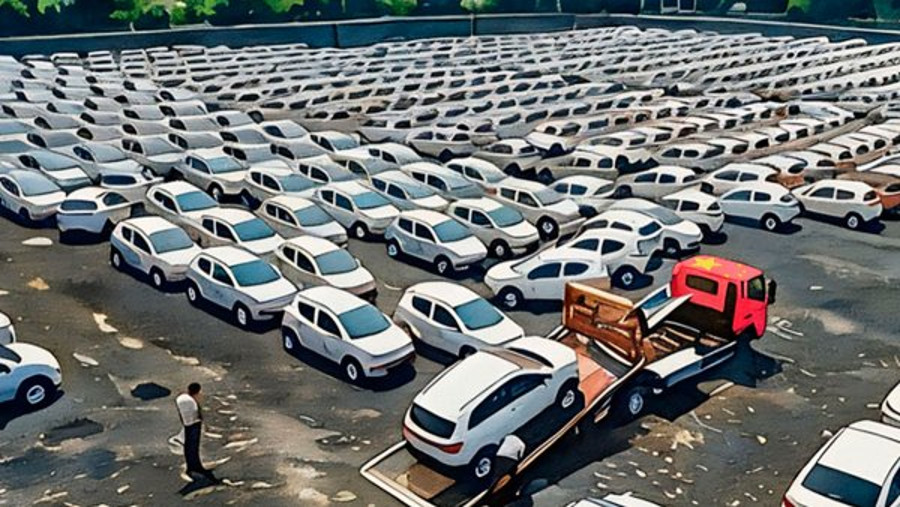
China's electric car empire is faltering: global success, domestic collapse? Last year, China reached 6.4 million units sold, reinforcing its status as the world's largest electric vehicle market. Another 4.9 million plug-in hybrids were sold. But installed capacity is much higher: The average utilization rate of Chinese auto factories was expected to be less than 50% in 2024, according to the Gasgoo Automotive Research Institute, a Shanghai-based think tank. Despite this, stocks of new passenger vehicles are piling up: Beijing authorities have expressed particular concern about the phenomenon of “zero-mileage” vehicles—cars appearing on the used market with zero odometers, indicating that automakers are artificially inflating their sales figures. This isn't just a planning error: it's the result of a national strategy that turned the electric car into the symbol of the new "Chinese dream," with generous subsidies, easy credit, and a frantic race by local governments, banks, and technology companies, which has enabled the growth of dozens of emerging automakers. The flip side is that the industrial enthusiasm for the electric vehicle revolution, fueled by years of incentives, has created a bubble of factories that now produce more than the market can absorb, creating a situation in which the status quo is increasingly impossible. Even domestic observers claim that industry consolidation and restructuring are long overdue. In 2024, there were 129 electric vehicle brands in China. But according to the Global Automotive Outlook 2025 report by the consultancy AlixPartners, only 15 will be financially capable of surviving beyond 2030. Despite the country having become synonymous with efficiency and technological leadership in the automotive industry, market saturation, slowing domestic growth, new global tariffs, and geopolitical tensions are pushing for unprecedented consolidation. Companies that cannot scale quickly, adapt to the international environment, or develop strong brands will disappear [ 1 ] . The price war: a path to the abyss The turning point came on May 23, 2025, when China's largest EV manufacturer shocked consumers by announcing drastic price cuts across 22 of its electric and hybrid models. The starting price of its popular Seagull model plummeted to just 55,800 yuan (approximately US$7,700), significantly lower than the already competitive 73,800 yuan (approximately US$10,000) at its launch two years earlier. On average, the price reduction was up to 34%. In a flash, what seemed like a one-time promotion morphed into a systemic price war. More than 70 models from other brands followed suit, initiating a deflationary spiral that has sunk the sector's profit margins to ridiculous levels: 3.9% in the first quarter of the year. By comparison, bubble tea chains in China are exceeding 20% profitability. As Andrea Ferrario rightly points out : We're facing a grotesque situation: a high-tech, capital-intensive sector competes for margins lower than those of sugary drink sales. Meanwhile, factories continue to operate at half speed, piling up vehicles in warehouses and eroding value on an industrial scale. For some analysts, such as Adrian Monck , Chinese car companies: “are bleeding money at a rate that would make even the most wasteful Silicon Valley startups blush” [ 2 ] . Financial risk: a chain about to break But the problem isn't just commercial: the sector's financial structure is a ticking time bomb. Chinese automakers face short-term debts of more than 2 trillion yuan ($278 billion), a figure far exceeding that of the beleaguered real estate sector. Unlike real estate developers, whose debt is concentrated in banks, automakers owe primarily to their suppliers, mostly small and medium-sized enterprises that lack the tools to pressure their debtors. When large manufacturers delay payments for months—as is already happening—these SMEs enter a zone of extreme vulnerability, multiplying the risk of chain bankruptcies. The imbalance ripples throughout the entire supply chain, threatening to trigger a systemic crisis in the real economy. BYD has recently come under pressure to defend its financial figures and business practices after Wei Jianjun, chairman of rival Great Wall Motor, called for a comprehensive audit of all major domestic automakers. “Right now, there is an Evergrande in the [Chinese] auto sector, but it simply hasn't exploded yet,” he told local media, raising the specter of the industry following in the footsteps of the real estate sector and spiraling into a debt crisis. Beijing takes note: a call for self-regulation Faced with the growing disorder, the Chinese government has begun to intervene. In a rare joint meeting, the top officials of the Ministry of Industry, the economic planning agency, and the market authority convened the major automakers—BYD, Geely, Xiaomi—to send a direct message: avoid price wars, don't sell below cost, and curb accounting practices such as selling "zero-mileage cars" to dealers or finance companies. In particular, the economic ministry is deeply concerned about the harmful effects that this cutthroat competition could have on investment in research and development (R&D) and even on vehicle safety. Days later, on June 1, the People's Daily , the influential media voice of the Communist Party, joined the criticism, arguing that low-priced and inferior quality products could erode the global reputation of the “made in China” brand [ 3 ] . The electric car is a political symbol, a geostrategic gamble of the Chinese development model. Its implosion would represent a systemic failure of the state-promoted capitalism promoted by Xi and the Communist Party in its most ambitious version. Giant with feet of clay? At stake is the fate of a sector hailed by President Xi Jinping as a pillar of China's economic future. Xi has spent the past five years trying to reorient the economy away from traditional growth drivers, such as real estate, and toward "new productive forces," such as auto manufacturing and clean energy. Strengthening the industry's financial health would help consolidate China's position as a global automotive powerhouse. However, the task remains daunting. The necessary economic rationalization—as Adrian Monck points out in the aforementioned article—is opposed by: …a web of competing interests within China is hindering healthy consolidation. “There’s a fundamental conflict: the central government wants healthy companies, but because the auto industry employs so many people, the incentives [for consolidation] aren’t aligned at the provincial level,” says Tu Le, general manager of Sino Auto Insights. Since 2020, Chinese automakers have added nearly 1 million jobs, according to an analysis of company annual reports by The Wire . At a time when China’s economy is slowing, consolidation could leave tens of thousands of people jobless—a politically costly outcome that local governments are keen to avoid at all costs. What was meant to be the flagship of the new technological China risks becoming a new symbol of overcapacity, indebtedness, and state coordination. As The Economist notes : Investment in manufacturing, especially in high-tech companies, has been a bright spot for the Chinese economy in recent years, which is experiencing a prolonged real estate crisis. But the rapid decline in industrial prices and profits has raised questions about the sustainability of even this capital spending boom. Industries such as electric cars, lithium-ion batteries, and solar panels were supposed to be the new engines of growth that would fill the enormous gap left by the real estate sector. Now they have also become drivers of deflation. In conclusion, once again, Beijing's restorationist bureaucracy has failed to achieve a new, more balanced and sustainable growth model. At the time of the 2021 crisis of the real estate giant Evergrande , whose overaccumulation and excessive production had given rise to a debt crisis, we wrote: The bureaucracy is seeking to square the circle: it wants to avoid the dire consequences of over-indebtedness without causing a sharp drop in growth for fear of its social consequences. Unless China discovers a completely new engine of economic growth to offset the enormous growth surplus generated by the debt now being channeled into unproductive investments, this issue has no non-traumatic solution. The "great leap forward" of the electric car was Beijing's bid to resolve this dilemma, but today, more than ever, the CCP bureaucracy still hasn't found the key to building its empire on solid foundations. Beijing's attempt to export more and more of its excess capacity faces not only increased opposition from established imperialist powers and the growing protectionism of the global economy, which took a new leap forward under Trump, but also capitalist economic rationality. But as the Financial Times points out : After 20 years of China's success in using supply to generate growth, saying goodbye isn't easy. In today's fragmented world, many people probably consider supply chain dominance more important than ever. The rebalancing of the Chinese economy is increasingly colliding not only with the internal contractions of the model (low mass consumption, or, in other words, a high rate of exploitation), but also with Beijing's geopolitical imperatives and the need to secure natural, mineral, and energy resources to ward off aggressive US policies. Perhaps in its attempt to advance and consolidate its imperialist ambitions, the bureaucracy is finding the domestic front to be its Achilles' heel. https://www.laizquierdadiario.com/El-imperio-de-los-coches-electricos-chinos-se-tambalea-exito-global-colapso-interno? Back |
 Links Search |
||||||
|
|||||||