|
|
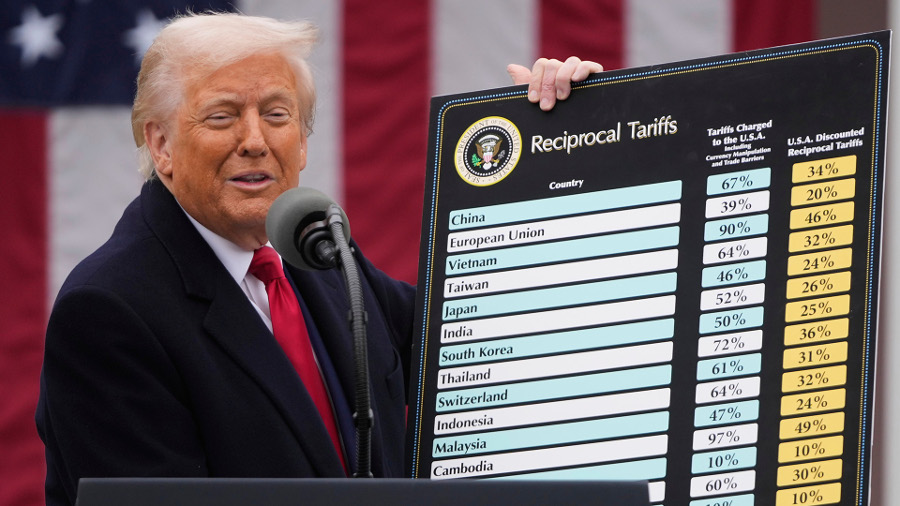
Real and fake antidotes to Trump’s latest tariffs There are four strategic options. First, meekly succumb; second, seek out new markets (especially in Africa and China) – which are ultimately fake antidotes, compared to two real ones: third, fight back collectively (e.g. in the G20 process); and fourth, stimulate the local economy. Consider each in turn. Obsequious SA The first, a ‘Plan A,’ was on display on May 21 in the White House Oval Office, and over lunch afterwards, in a disturbingly servile manner, e.g. golfer Ernie Els thanking Trump that Washington supported the apartheid-era army (in which he served in 1988-89), during Pretoria’s war against Angola from the mid-1970s. Obsequious behaviour is not unusual; recall that, as Trump put it on April 8, “these countries are calling us up, kissing my ass, they are. They are dying to make a deal: ‘please please sir.’” Aside from Ramaphosa’s plaintive appeal (‘please please, sir,’ won’t you play golf with me?), Trade Minister Parks Tau’s bend-the-knee offer to Trump – never made public but leaked to some extent – is that local consumers will buy much more U.S.-sourced methane gas and oil. At the same time, the New York Times reported, Minerals and Petroleum Minister Gwede Mantashe would be asked to hand over SA’s own undeveloped offshore oil and gas leases to U.S. Big Oil. Successful environmental and community litigation plus more than a hundred shoreline protests against such drilling, starting in late 2021, went unmentioned. Oil buying was already being unilaterally implemented in April, as SA purchased crude petroleum worth $80 million that month, double the level from the U.S. in April 2024. Yet Trump’s temporary 10% tariffs were already kicking in by the end of April 2025 (the last data available), with crashes of major SA exports to the U.S., compared to the same month in 2024: automobile sales down by $79 million (-52%), platinum by $56 million (-17.1%) and diamonds by $34 million (-63.9%). So Plan A has unequivocally failed. Chinese and African trade roadblocks On July 8, even the ordinarily-optimistic, always-soothing Cyril Ramaphosa had to finally order “government trade negotiations teams and SA companies to accelerate their diversification efforts in order to promote better resilience in both global supply chains and the SA economy.” If Plan B is to diversify exports, the two most hyped growth prospects are the African continent and China. However, Chinese exporters to the U.S. now face a 51% average tariff, up from 21% in January. Therefore, managers of ultra-productive Chinese economic sectors must address their own vast industrial overcapacity by ‘going out’ (finding new markets), in view of declining U.S. imports of Chinese goods: 35% lower in value in April this year than last. But according to anti-dumping regulator Zuko Ntsangani of Pretoria’s International Trade Administration Commission, “SA remains particularly vulnerable to the potential spillover effects of such conflicts” with the U.S., due to displacement of Chinese production. In the last few years, Ntsangani’s team imposed anti-dumping tariffs on Chinese tyres (15%), steel products (53%), and bolts and screws (166%). In February, the Commission also found that flat-rolled Chinese steel was “being dumped in the Southern African Customs Union market, causing material injury to SACU industry.” As for the African Continental Free Trade Agreement (AfCFTA), it is encouraging in theory but has not delivered. The most rigorous study of reasons why, by the Geneva-based South Centre, highlights “poor transport and logistics network; the prevalence of non-tariff barriers and disputes; limitations to movement of persons; multiple Rules of Origin regimes; multiplicity and overlapping memberships; similarity in trade basket of goods; gaps in labour provisions; free trade agreements with third parties; rushed negotiations and hollow protocols; and high donor dependence.” We might add political instability that leads African autocrats to shut down their internet (in 15 countries since 2020) and close their borders to trade and migration, such as occurred since the AfCFTA came into effect (unrelated to Covid-19) in Benin from 2023-today, Burkina Faso in 2022, Burundi-Rwanda in 2024, Ethiopia-Sudan in 2021-22, Mali in 2020-21, Mozambique-SA in 2024-25 and Niger in 2023. Counter-attack Plan C would be to fight back against Trump, ideally with collective strength. Recall the precedent of Beijing’s own ban on exporting rare earth elements to U.S. corporations, which in turn caused a so-called ‘Trump Always Chickens Out’ (Taco) reversal by the White House in May. Such an approach was posed first by Mantashe at a mining conference in February: “Let’s withhold minerals from the U.S. That is it. If they don’t give us money, let us not give them minerals.” In the wake of the new tariffs, Mantashe’s idea was resurrected this week by Daily Maverick’s Steven Grootes: “I thought people were wrong to laugh at him so quickly when he first said Africa should consider refusing to export its minerals to the U.S. Probably our biggest lever of the moment is platinum: prices have jumped dramatically in the past two months, mainly because of a scarcity of supply.” Were there political will, it would be easy to start an OPEC-like supplier’s cartel for platinum, in view SA holding 80+% of world reserves, and also having concentrations of chromite and manganese close to 40% of world reserves. The main leverage against Trump, however, could be Ramaphosa’s hosting of the G20. In March 2014, the Western powers in the G8 expelled Russia due to its invasion of Crimea. To be sure, G20 members include three likely Trump allies – Argentina’s Javier Milei, Italy’s Giorgia Meloni and Saudi Arabia’s Mohammed bin Salman – but they are far outnumbered by Trump critics. The U.S. state and business (‘B20’) delegation should be temporarily expelled – voted off the G20 island – if Ramaphosa is serious about those “diversification efforts in order to promote better resilience,” not only in local economic terms, but also in areas of global crisis. Trump has pulled out of UN climate negotiations and the World Health Organisation, even though extreme weather and new pandemic potentials are devastating. Trump not only chopped international climate financing and AIDS medicines support in February, but also emergency food aid. A British Lancet academic study has just reported rigorous predictions of 2.4 million premature deaths annually through at least 2030 due solely to the closure of USAID, not to mention the damage Trump is doing to nearly 12 million low-income U.S. citizens by ending health insurance via his new corporate tax-cut legislation. That law further destabilises world finance by adding $3.4 trillion to the U.S. public debt. Trump’s imperialist bullying has caused trade and financial chaos across the world, tearing asunder global value chains and creating major new inefficiencies in capitalist production and commerce. And in West Asia, his geopolitical agenda, his increased arms supplies to Israel, and Pentagon adventurism are contributing to genocide and new wars, as could his notorious Sinophobia. Trump’s hostility to immigrants, his neo-fascist deportation methods and his cancellation of progressives’ free speech have erased the very idea of human rights in the U.S. Trump’s reactionary social agenda, including open racism, will always prevent him and foreign minister Marco Rubio from endorsing G20 themes of solidarity, equality and sustainability. For Trump to host the G20 next year would make all the work now underway an utter waste of time; far better to ask Mexican President Claudio Sheinbaum to prepare 2026 hosting of the G19. Local, efficient use of resources Adopting Plan C would put SA onto the global economic-justice map – in the way its defense of Palestinian survival and the integrity of the international courts via genocide charges against Israel, and ‘Hague Group’ co-leadership, have made Pretoria the world’s leading moral force. But in addition to fighting back for global justice, Plan D is needed: redirecting resources to local markets. The decline of steel is an example: from 6.4 million tonnes produced in 2014 to 4.7 million a decade later. Local consumption in 2024 was only 4.1 million tonnes, of which a third was imported from China, in turn putting pressure on ArcelorMittal to accelerate foundry closures. Genuine reindustrialisation would require, as the SA Federation of Trade Unions demands, public ownership: “It is clear that privatisation has failed. The steel industry must be reclaimed as a public asset to safeguard jobs, rebuild local production capacity, and restore SA’s industrial sovereignty.” The same for the main aluminium plant, BHP Billiton’s South32 smelter in Richards Bay. It guzzles 5% of the country’s electricity mainly for foreign buyers to the detriment of over-charged SA industry, resulting in few local economic linkages. Worse, before what was a secretive price increase in 2021, South32 paid only R0.22/kWh, about 15% (1/7th) of the price ordinary people paid then at even the lowest consumption level. The 1955 Freedom Charter and 1994 Reconstruction and Development Programme are the kinds of visionary statements aimed at restructuring an unfair economy, one self-destructively addicted to export of barely-processed raw materials to the neo-colonial West. Will the National Dialogue process and August 15 Convention move society in that direction, or will we once again suffer the typical self-interest of elites: mere tinkering with the economic status quo, as Trump kicks SA’s exporting corporations – and their employees – in the teeth? https://www.cadtm.org/Real-and-fake-antidotes-to-Trump-s-latest-tariffs-seen-from-South-Africa Back |
 Links Search |
||||||
|
|||||||