|
|
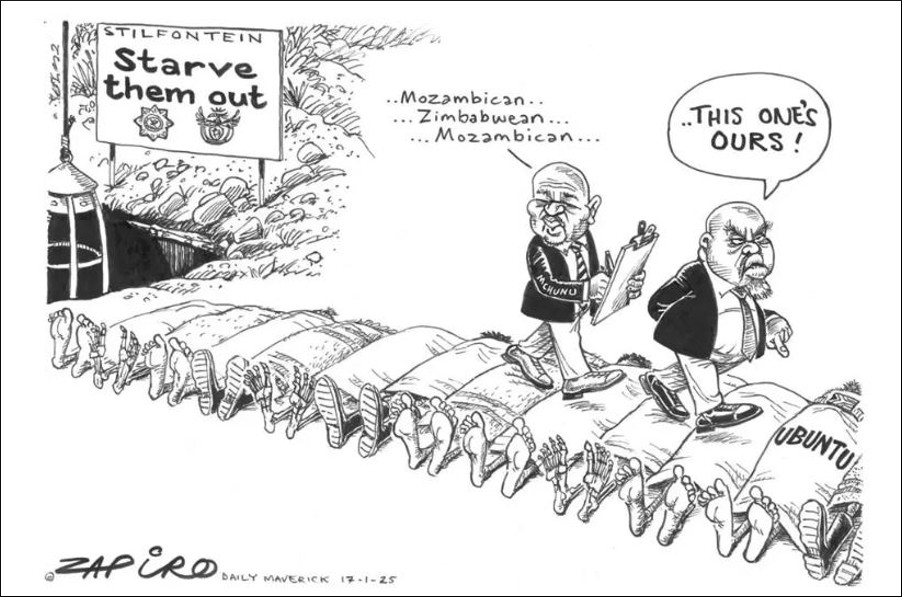
South Africa’s Stilfontein mine disaster reveals a regional labour crisis Multiple forms of extractive exploitation About two hours’ drive southwest of Johannesburg, old gold mines established in the 1940s-60s stretch across the landscape. Their depth of 2.8 kilometres – indeed 4 kilometres at the Carletonville mine halfway from Stilfontein to Johannesburg – reaches into the world’s most prolific seam. Indeed the Reef’s gold, discovered in the mid-1880s, comprised at its peak half the world’s historic gold reserves. But alongside exhausted gold, diamond, coal, platinum, manganese, iron ore, and other mineral lodes for which South Africa is infamous, are detritus of capitalist degradation: more than 6,000 mines were never shut properly. Once considered exhausted for the sake of formal mining, many are being picked clean by desperate artisanal mineworkers. Residues still exist — e.g., in the columns that hold up roofs that are over a century old, or in scrapings along the tunnel walls — all of which are exceptionally hazardous. Writing on conditions at Stilfontein, Sunday Times reporter Isaac Mahlangu described “an underground hierarchy in which those who did the digging and mining at the lowest levels were mainly foreigners, the majority from Mozambique. Very few South Africans did this work. Those at higher levels were rope-pullers or were involved in processing the gold. Others were tasked with distributing food… gold dust was the main currency for buying goods from the shop deep underground on level 10.” One worker told him, “‘The gold that fills a Colgate [toothpaste] cap is worth R3,000 [$162] underground, although the shop does not give change.’” A 5-kilogram bag of maize meal costs R5,000 [$270], which is 25 times its cost above ground. Accounts are still emerging of the way police and the hard-to-track corporate directors responsible at Stilfontein Gold Mining (who had long ago abandoned the site) contributed to the mass murder. Although capital is responsible for extreme environmental, social, and economic irresponsibility across the Reef, many in South Africa were provoked into making heartless, xenophobic remarks. They were egged on by high-profile right-wing populists catching the energy of the Trump Effect. As pressure rose to save the mineworkers’ lives, Deputy Police Minister Shela Polly Boshielo announced, “We are setting a wrong precedent, to say ‘people can get under the ground, do illegal mining, get all the money and everything, and then we will then come and rescue them as government’… So we are not even dealing with South Africans, who really, you can say, they’re trying to make a living. They are not. They are illegal.” Even more vitriolic remarks were made by Patriotic Alliance Deputy President Kenny Kunene: “I have no sympathy for those who have died stealing the wealth of our country… I have absolutely no sympathy. They must die like rats underground there, all of them. They must burn in hell.” A common theme is that the artisanal mineworkers steal from society, as implied by another politician, Action SA President Herman Mashaba, who said, “I personally have got no sympathy whatsoever for criminality.” Also in mid-January, Minerals and Petroleum Resources Minister Gwede Mantashe announced his opposition to local community activists who suggested regularisation of artisanal mining, i.e., that his ministry “give licences to steal gold to Mozambicans, Zimbabweans and Lesotho nationals. It’s a criminal activity. It’s an attack on our economy by foreign nationals in the main.” Mantashe attempted to put a number to the theft: “Illegal mining is a war on the economy… it is criminals attacking the economy. Precious metals illicit trade is estimated in 2024 to about R60 billion ($3.2 billion), a leakage on the value of the economy of the country.” Against sub-imperialism There are three possible replies to xenophobes. The first appeals to basic ‘ubuntu’ humanistic values (“we are who we are through others”). The most active trade union supporter is General Industries Workers Union of South Africa president Mametlwe Sebei, who is also a human rights lawyer. As two government ministers (Mantashe and the police minister) visited Stilfontein in mid-January, Sebei told a community meeting not far from the mine shafts: “These ministers are here at the scene of the crime. Hundreds of miners have died underground in what can only be a bloody culmination of their treacherous policies of the police operation, planned and executed with the approval at the highest echelons of the state, including the Cabinet.” The community responded by refusing to hear the ministers, forcing them to retreat in shame. A second rebuttal is to point out that compared to the artisanal mineworkers’ low-tech extraction systems, there is a vast outflow of mineral wealth carried out by multinational mining corporations, nowhere near compensated for by reinvestment in the economy, society, and infrastructure. A third is that surplus value feeding South African capitalism has been drawn from immigrant workers dating back at least 150 years, and those countries are today themselves resource-cursed by Johannesburg firms. As explained by Solomon Mondlane from Mozambique’s opposition Democratic Alliance Coalition, “50% of our gas in Mozambique goes to South Africa. 80% of our electricity in Mozambique goes to South Africa. And they buy it on a less amount, while here in Mozambique, we pay double the amount for what is produced in our country. And they will tell us we are busy flocking into their countries, when in actual fact our country is being looted by South Africa.” The best-known South African labour leader, Zwelinzima Vavi of the SA Federation of Trade Unions, agreed: “South Africa is often being accused of being a sub-imperialist and playing that role to its neighbours and to the rest of the African continent. Our daughters and sons [serving in the SA military] have been sent to the northern parts of Mozambique to fight a war on behalf of multinational companies [Total, ExxonMobil, ENI, BP, etc.] that are lining up to exploit the massive gas fields around Cabo Delgado. And they have been there, of course, with a clear instruction from France. The French President, if you remember, came unscheduled to Union Buildings [in May 2021], clearly to lobby South Africa to ensure that it has soldiers to put guards on the vast gas fields in the northern parts of Mozambique.” Vavi continued, “This is what makes me sick — when people say, ‘They are stealing our mines, they are stealing our gold.’ Hold on, what are you talking about? Whose gold? How have you benefited, as a black South African, from this gold that you want to protect? And to celebrate the death of 78 people ‘who are stealing our gold and who are illegal foreign nationals’? Mozambicans do not come to South Africa by choice. They do not cross the Kruger National Park such that they discover only a wallet [after immigrants are eaten by lions, leopards and hyenas], when a whole body cannot be traced… If you were to spend four or five days in a week with your children crying to you, sitting helplessly, not knowing what to do? People are driven by desperation. The fact that most of the people who are being rescued in these mines — ‘zama zamas’ — are from Mozambique is not a coincidence. It’s because the revolution there failed, just like the revolution here in South Africa is failing.” Ramaphosa’s own failings are indisputable; once the leader of the National Union of Mineworkers, his major investment in Lonmin in 2012 led him to treat a wildcat strike as ‘dastardly criminal’ in emails he wrote 24 hours before the police massacred 34 platinum rock-drill operators demanding a $1000/month wage. Ramaphosa was a board member of Lonmin and had advised the company to continue offshore illicit financial flows. Going forward, we must rebuild South African solidarity with those struggling in Mozambique – a solidarity which had motivated student protests in 1976 not long after left-nationalists beat brutal Portuguese colonialists to win independence. That solidarity is needed today to forge stronger community-worker ties, especially as new rebels have risen up against the now-corrupted nationalists. That’s the agenda being forged by the artisanal miners themselves, backed by GIWUSA, SAFTU, Mining Affected Communities United in Action, and progressive lawyers. As they take forward demands for a Commission of Enquiry into the hundreds of deaths, part of the work is a psychological reversal of the hatred found in state and society. This is necessary so that the ‘stealing’ of sovereign mineral wealth is better understood — and so that internationalism replaces xenophobia. https://globallabourcolumn.org/2025/01/30/south-africas-stilfontein-mine-disaster-reveals-a-regional-labour-crisis/ Back Patrick Bond teaches at the University of Johannesburg, where he directs the Centre for Social Change. |
 |
||||||
|
|||||||