|
|
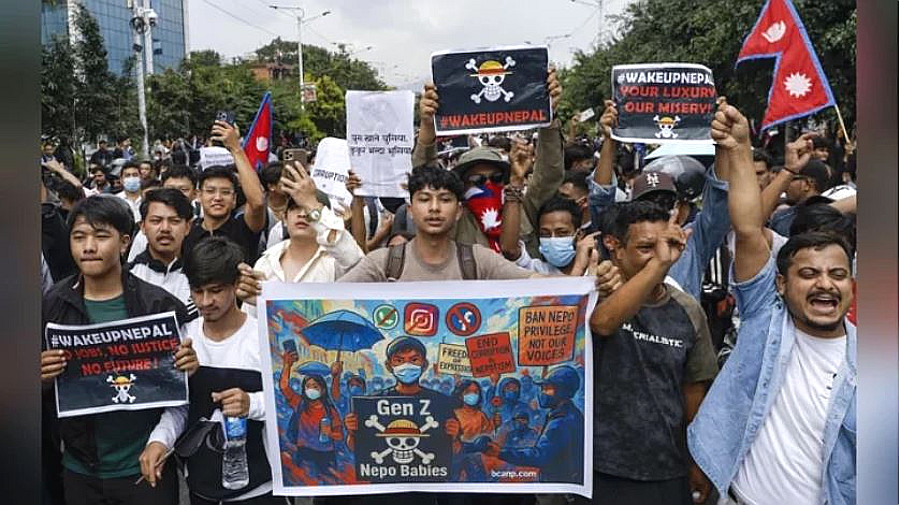
A generation's rebellion against corruption in Nepal To understand the depth of the current frustration, it is necessary to look back. Until 2006, Nepal was the last Hindu kingdom in the world, ruled by an absolutist monarchy that stifled any dissent for decades. A bloody civil war (1996-2006) between the monarchy and Maoist insurgents left more than 17,000 dead and seemed to pave the way for radical change with the establishment of a parliamentary monarchy. But neither the civil war nor the fake democracy of the 1990s managed to break with corruption and nepotism. In 2008, the monarchy was abolished and Nepal declared itself a federal democratic republic. For many, a period of hope opened. A new constitution was drafted in 2015, establishing a secular system and promising an era of peace, prosperity, and inclusion. Since then, the country has had more than ten prime ministers, almost all from "communist" parties adapted to the capitalist system and corruption. Instead of distributing power, the new regime concentrated it in a new elite: the leaders of the traditional parties, the Nepali Congress, the Communist Party of Nepal (CPN), and the former Maoists. The same figures, such as Sher Bahadur Deuba, KP Sharma Oli, and Pushpa Kamal Dahal "Prachanda," alternated in power over and over again over the past 17 years, sharing ministries and privileges while the country stagnated. "Regime change" never came: bourgeois democracy ended up being a factory of privileges for the same old people. Systemic Corruption and the Social Abyss The system these parties built operates on a deeply rooted network of patronage and corruption. Government and state-owned enterprise positions are distributed among loyalists, not based on merit. Major infrastructure projects, often financed by loans from China or India, are plagued by price overruns and endless delays, enriching politicians and contractors while leaving unfinished highways and ghost airports in their wake. While the political class enriches itself, life for ordinary citizens is a constant struggle. Unemployment and underemployment are endemic, especially among young people. According to estimates, it can reach 20 or 30%. The formal economy is unable to absorb the hundreds of thousands who graduate each year. The only way out for millions of Nepalis is migration. It is estimated that one in four households depends on remittances sent by relatives working in often precarious conditions in Qatar, Malaysia, the United Arab Emirates, or India. This is a constant drain of youth talent and strength. In the last year alone, some 740,000 workers left the country in search of work. Education and healthcare, supposed pillars of a modern state, are unaffordable luxuries for many. Families go into debt to pay for quality private education, as public education is deficient. Public healthcare is inadequate, and a medical emergency can ruin a family financially forever. This panorama of precariousness clashes violently with the opulence of the political class and its cronies. This is where the figure of the nepobaby (a term adopted from the English nepo-baby, or "nepotism baby") emerges, taking on a particularly poignant dimension in Nepal. It refers to the sons and daughters of powerful political leaders who, without apparent merit, inherit seats in parliament, party leadership positions, state contracts, and embassies. While an ordinary young man must emigrate to become a security guard in Doha, nepobabies access a life of privilege and power simply because of their lineage, perpetuating a modern political caste system that is as exclusionary as the old one. Organic Rebellion or Geopolitical Game? The horizontal and decentralized nature of the protests, driven by social media and lacking a clear leadership that can be co-opted or arrested, is the main argument for considering it an organic rebellion. As The New York Times reports, the protesters openly reject any association with existing parties. Their anger is genuine, born from the lived experience of disappointment. However, as The Times of India's analysis cleverly points out, in a country with Nepal's geopolitical situation, one can never be completely safe. Nepal has historically engaged in a delicate balancing act between its two giant neighbors, India and China. New Delhi has traditionally wielded significant influence in Nepalese politics, while Beijing, through massive infrastructure investments under its New Silk Road initiative, has increased its economic and political clout. For its part, Washington is closely monitoring the instability in a country it considers within its sphere of interest to contain Chinese influence in Asia. Given this scenario, the question arises: could external actors be exploiting legitimate discontent to push for a favorable "regime change"? Are intelligence agencies trying to influence or direct the protests from the shadows? While there is no clear evidence of this—and popular anger seems too genuine to be an externally manufactured product—distrust and the possibility of interference are specters that always loom over any crisis in Nepal. Former Prime Minister Oli himself accused "spurious interests" of hijacking the protest, and various theories circulated about external interference: the CIA behind the social media, Chinese maneuvers to protect TikTok. But so far, the facts show a fed-up youth moving in their own interests, not those of foreign powers. The fight continues: a system that no longer works Oli's fall, achieved after repression and the burning of elite homes and buildings, was celebrated as a popular victory. The government lifted the internet blackout, but it was too late: the people showed they would no longer tolerate the corruption and contempt of those in power. The underlying theme, however, remains unchanged: Nepal is a laboratory of dependent capitalism, where democracy only works for the rich and where youth and the working class have no choice but to organize independently, without trusting traditional parties or powers that only seek their share. The rebellion of the Nepalese Generation Z is, at its core, a lesson for the entire global south: when anger is organized, neither censorship nor bullets are enough to stop it. What is certain is that Nepal has reached a breaking point. The burning of symbols of political power is not a senseless act of vandalism; it is a failed purification ritual, a desperate attempt to burn away the past to force a new beginning. Nepal's Generation Z is not just fighting for a change of government, but for a change of system. They demand an end to impunity, a future that does not depend on a foreign passport, and the opportunity to build their country without the burden of "nepobabies" and corrupt politicians. Their success or failure will not only redefine Nepal's future but will resonate in every country where a young generation feels betrayed by the broken promises of democracy. https://www.laizquierdadiario.com/La-rebelion-de-una-generacion-contra-la-corrupcion-en-Nepal? Back |
 Links Search |
||||||
|
|||||||