|
|
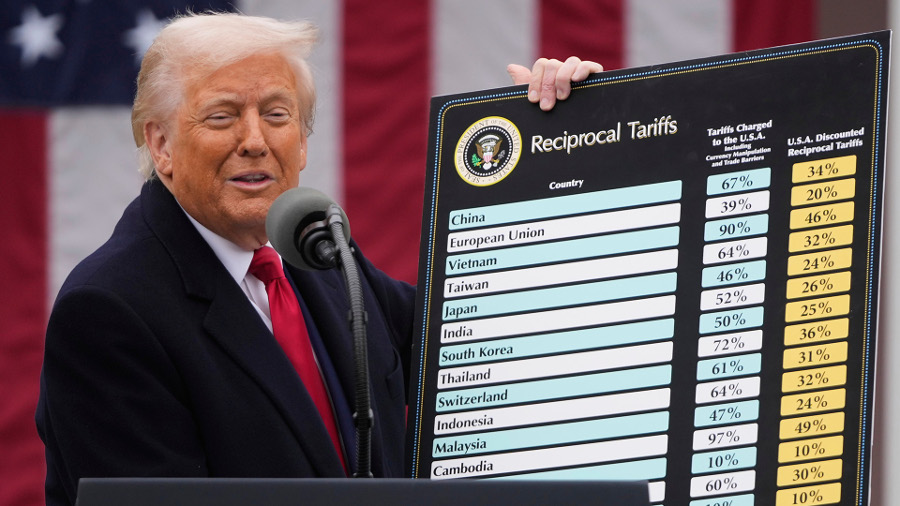
Pretoria Fires Back as Trump Calls for South Africa’s Removal from G20 But as your viewers can see, Trump is actually beating us to it by putting this into the public sphere—that there could be a winnowing away of the G20 to make sure that the economies, the countries, the leaderships that are not constructive actually aren’t part of it. Now, he thinks that’s South Africa because he’s got a made-up, completely fictional notion that Afrikaner farmers are under some sort of political, social, and economic pressure. In reality, the only pressure that the Afrikaner farmers I’ve talked to are under is from Donald Trump’s own tariffs that hit in August on citrus, nuts, and vineyard products. So I think what we’re looking at is a very clear sense that Donald Trump has left reality behind—just the way he did last week with his threats to invade Nigeria on the question of the oppression of Christians. He’s got a very clear sense that he’s talking now to his own base—racists, and in some senses, the born-again Christians—and he’s not actually dealing with the realities of geopolitics. Joanna : Right. And like you said, Nigeria, we have our own conversation going on. But let’s focus on the G20 and his threats to boot South Africa out. You’re basically saying his reasons are not founded, especially with his talk around violence against Afrikaners. But what are the possibilities of this happening, and how are member states going to play along with this, including South Africa? What’s their reaction to this? Patrick: Well, the South African government on Saturday responded with a very mealy-mouthed, very obsequious statement saying that Trump isn’t correct, very mild-mannered. Then the African National Congress, the co-ruling party that comes from an anti-imperialist tradition, was more direct. I think a crucial problem is that not only South Africa and Nigeria—which is indeed a member of the G20 via the African Union, which in 2023 became a formal member just like the European Union—but if you put the AU and probably most of the EU, with the exception of Italy, and most of the rest except perhaps Saudi Arabia and Argentina, where Mohammed bin Salman and Javier Milei are pro-Trump, I think all the rest of the countries in the G20 would actually reverse this vote, that Trump would expect. You have to win such an argument by consensus. Obviously, Trump is just blowing smoke. But there was a time in 2014 when Barack Obama was able to kick Russia out of what was then called the G8, now the G7, just after the invasion of Crimea within Ukraine. Those are the sorts of big geopolitical conflicts that I think we need to have. I think we need concerted effort to punish Donald Trump for the destruction—pulling out of the climate change summit that’s beginning in Brazil today, pulling out of the World Health Organization, ending US aid (which creates massive havoc with food and emergency humanitarian aid), and also creating such an extraordinary mess with world trade and finance. To me, this means that if South Africa and other countries stood up with a straighter spine and a stronger will, we could actually say to the US, “We should vote you off the G20 island.” That’s what many of us would like to see happen before the G20 begins or when the heads of state meet, which is 11 days from now here in Johannesburg—on the 22nd and 23rd of this month—the G20 annual leaders’ summit. Joanna : And I was going to ask—of course, the United States has the next presidency, and they seem to already be letting known their plans. We know that the G20, as opposed to the G7, represents a larger, more diverse group including major as well as emerging economies. How do you perceive a US presidency, especially under Trump, of the G20 panning out, especially with the agenda he seems to be pushing at the moment? Patrick: Of course, Donald Trump’s ideology is what we could call paleoconservative. It’s isolationist, racist, xenophobic, misogynist, and transphobic. It’s basically the paranoia of the white male feeling that they are being dislodged from their position of historic power. And the other element of this ideology in Washington is called neoconservative—that’s the old George W. Bush and, to some extent, Barack Obama approach—represented best perhaps by Marco Rubio, their secretary of state, and by Lindsey Graham in the Senate. The combination is really vicious. That’s where you get the cuts to US aid or the dramatic dropping out of the climate summit and the World Health Organization. These are the sorts of angles that these very right-wing forces within the US are pursuing. They’ve already said that the things being done here in South Africa—such as the G20 looking at African debt—are irrelevant. Our country, with $170 billion in foreign debt, and others like Zambia, Ghana, and Ethiopia have technically gone bankrupt. But Donald Trump won’t care about that. He won’t care about climate, public health, or food security—only finance. And just as a last point, you’re right that in 2008, the G8 (now G7) needed more money because of a US-centered financial crisis. That’s why they brought in other countries into the G20. That may well be the same situation Trump faces within a year because of the volatility, the artificial intelligence bubble in the stock markets, and the climate catastrophes creating havoc in Africa and the US. Joanna : South Africa is the only African country on the G20. What this could mean and how Africa is engaging with some of these multilateral institutions—let’s get into that. South Africa is the only African nation in the G20, aside from the African Union’s membership. You’ve said the likelihood of Trump’s threat being seen through, booting South Africa off, is not likely because consensus is needed. But this also calls into question having more African nations represented on the G20 as opposed to what Trump is pushing for. Patrick: Well, yes—and of course also in the United Nations Security Council and leadership positions at major institutions, reforms have long been called for but little has happened. The basic problem is Western power in combination with the BRICS—Brazil, Russia, India, China, South Africa—now joined by Nigeria and Uganda, and new African members like Ethiopia and Egypt. They haven’t really changed the power balance. What I worry about is that both today in Brazil, when the G20 countries again lead the climate summit (with the exception of Trump, who walked out), and here in Johannesburg 11 days from now, this will be the ganging up of the rich and middle countries against Africa. Because the crucial points—debt and climate—are being mishandled. The South African government is actually increasing its carbon emissions through new methane gas and cheap electricity supplies to smelters, even while we’re in an economic recession. There’s a big contradiction between talking green and walking dirty. There are agreements between the G20 major powers—the United States, Brazil, India, and China—that go back to Barack Obama in 2009 in Copenhagen. Those agreements are, number one, don’t cut emissions to the extent necessary; number two, don’t acknowledge that you have a climate debt or polluter-pays liability; and number three, privatize the air through carbon markets. I’d add one more thing to that, which is that unfortunately, the South African government has chosen as its main committee leader for dealing with African foreign debt Trevor Manuel, our former finance minister. He is currently the chair of Old Mutual, the biggest insurance company in Africa, and the deputy chair of Rothschilds. Both those institutions have portfolios including African sovereign debt. Therefore, he is in a direct conflict of interest where his material interests are to have high interest rates and repayments. The interests of Africa are exactly the opposite: to question odious debt—the debt from corrupt deals—and to get cheaper interest rates, more subsidies, and less private sector squeezing of Africa, which we’ve seen for about 10 to 15 years. Whether it comes from Chinese private firms and their state banks, or the Eurobond markets where many African countries were borrowing, or the IMF and World Bank backing up commercial banks, the outcome has been the same. I think this is the real chance to ask the question: doesn’t the West—and the BRICS too—owe African countries a climate debt payment? That should cancel out the financial debt that Africa owes the West and the BRICS. Joanna : I do recall our president at the last BRICS summit bringing that conversation up. Whether or not it will happen, we’ll have to wait and see. And I also remember you’ve called this “talk left, walk right,” or the other way around? Patrick: It’s “talk left, walk right,” because you often get a Third-Worldist critique of the West, especially from the BRICS. Then you find the BRICS moving up into the West’s institutions. One example that will be very poignant: in 2016, the West allowed the BRICS to have a much greater share of the IMF, and China, for example, increased its holdings by 37%. But what was the result? Nigeria lost 41% of its power. So the middle is increasing by stepping on the heads of the poor. That’s the “talk left, walk right” approach that still predominates in geopolitics, unfortunately. Joanna : Finally, before we let you go, we are seeing—and I’d like to get your assessment—Africa’s play with some of these multilateral institutions. What’s your assessment of that? And even beyond the global ones, locally and continentally, the regional blocs—what are your thoughts on how countries in Africa and Africa as a whole are engaging these institutions? Patrick: With the exception of occasional mavericks from places like Nigeria—I’m thinking of Charles Soludo, the former central banker who could stand up to the West and make very strong points—mostly, it’s assimilation of Africans. That includes, from South Africa, Trevor Manuel, who as I said is running this African debt He was the chair of the IMF and the World Bank’s Development Committee one year, as is currently our central bank governor, Lesetja Kganyago. That’s the problem, and it’s one that Frantz Fanon described quite a while ago. He observed that there was, unfortunately, a tendency for some African leaders to become the transmission belt of the West. I can see that in so many countries. The only solution is what we’ve been seeing in places like Zambia last week, Madagascar the week before, Morocco a couple of weeks before that, and then Tunisia and Kenya. There is an upsurge of anger from the new Gen Z activists who say, “We don’t want to see more elites from our countries tapping into the West and into the BRICS. We’d rather see full questioning.” In Kenya, for example, they demand a debt audit. They are asking, “Who really owes what to whom? Shouldn’t we cancel it and give the next generations a chance at a decent life?” I hope that’s the spirit that more Africans will pick up—especially if they can see, in Johannesburg, some very disappointing outcomes about 12 days from now when the G20 wraps up on Sunday the 23rd. It won’t really make any difference to the lives of ordinary Africans because of this adverse power balance. Joanna : All right. Of course, we’ll be tracking all that and more at the G20 summits happening in South Africa on the 22nd and 23rd of November. Thank you so much for your time, Professor Patrick Bond, professor at the University of Johannesburg and political economist. We do appreciate it. Patrick: Thank you. https://www.youtube.com/watch?v=GApkfGTdgc4 Back |
 |
||||||
|
|||||||