|
|
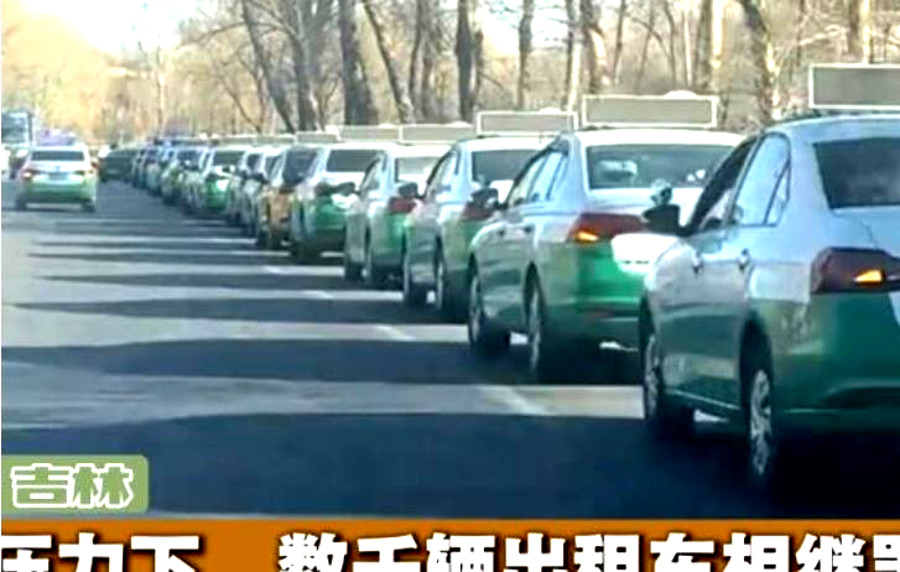
Northeast China Taxi Drivers' Strike and Protests Meanwhile, the overall economy of Northeast China has been in a prolonged slump, with a continuous outflow of population. While this is not an isolated case—a quarter of Chinese people live in shrinking cities*—the outflow is most pronounced in the Northeast. Government data shows that Fuxin's permanent resident population plummeted from 1.647 million in 2020 to 1.541 million in early 2025, a loss of over 100,000 people in just five years, primarily young and middle-aged adults—directly weakening the already limited demand for taxi passengers. Faced with shrinking demand, vehicle surplus, high costs, and the government's unwillingness and inability to regulate, taxi drivers are left with virtually no way out, resorting to strikes and physical confrontations with other transportation industries as a means of survival. This situation would not occur under a democratic planned economy, and democratic planning has never existed under the CCP's rule, neither during the Mao era of top-down rule nor under the current capitalist CCP regime. Under pressure from protests, Fuxin's transportation enforcement department promised to remove unlicensed vehicles from ride-hailing platforms; subsequently, in December, the government raised the local taxi starting fare by 1 yuan. However, even removing ride-hailing vehicles was merely a stopgap measure; the so-called "profits for drivers" were opposed by most drivers. Given the weak economy and declining population, raising the starting fare would only further deter passengers and worsen revenue. Many drivers refused to charge passengers the extra 1 yuan starting fare. In many cities in Northeast China, the taxi industry has monopolized point-to-point transportation services, resorting to violent exclusion tactics against competitors. In Jinzhou, taxi drivers collectively threw shared bicycles into a river; they also blocked ride-hailing vehicles and reported them to transportation management departments, resulting in hefty fines of tens of thousands of yuan. Residents of many cities in Northeast China complain online that taxi drivers have "monopolized the market," driving away cheaper and more convenient ride-hailing and shared electric bicycle companies, forcing consumers to accept taxis with the risk of deliberate detours, refusal to pick up passengers, and exorbitant fares. This is actually a tactic by the government to deliberately loosen regulations and divide the workforce, because this monopoly is a direct result of local governments' past practice of inflating license prices. The government leaves the blame to taxi drivers while feigning innocence. Many taxi drivers in Northeast China are former state-owned enterprise workers who lack other employment opportunities and have almost no other skills to make a living besides driving a taxi. Local governments in Northeast China are unable to provide jobs due to the economic recession, and taxi companies generally do not pay social security contributions for drivers. This means that drivers cannot receive pensions, are forced to struggle for a living, and become "ghosts of the old era" in the eyes of the public, resisting new things—and these "ghosts" are the victims and descendants of the collapse of the traditional state-owned economic sector in Northeast China after the shock therapy. In today's world, where autonomous driving technology is maturing and ride-hailing services are replacing taxis, improving the lives of taxi drivers cannot be limited to the struggle for survival. It requires fighting to establish independent unions, uniting and organizing the struggles of taxi drivers, other transportation workers, and gig workers. Otherwise, the working class will be fragmented into different groups, entirely subject to employers, platform companies, and the capitalist Chinese Communist Party. Socialists advocate for the democratic public ownership of local taxi companies, encompassing citizens, taxi drivers, and platform programmers—the working class. Many would support this idea, but it can only be achieved if workers break free of their shackles and establish independent unions. Guided by the interests of the working class and the public good, rather than the profits of transportation management departments and large corporations, this would involve hiring more employees, reducing working hours without lowering wages, and collectively building a fully integrated and environmentally safe transportation service that allows taxi drivers to maintain a decent standard of living while providing convenient travel for citizens. For cities with saturated taxi capacity, the government, under the control of independent unions, should provide free retraining, good working conditions, and well-paid new jobs, along with pensions and free healthcare for all employees reaching retirement age. Such demands are clearly unrealistic under a capitalist system; it necessitates a democratic socialist public ownership society. * The South China Morning Post reported on April 12 , 2025 , that 701 cities have seen their populations decline by at least 5 % over the past 10 years . https://chinaworker.info/zh-hant/2025/12/15/48485/ Back |
 |
||||||
|
|||||||