|
|
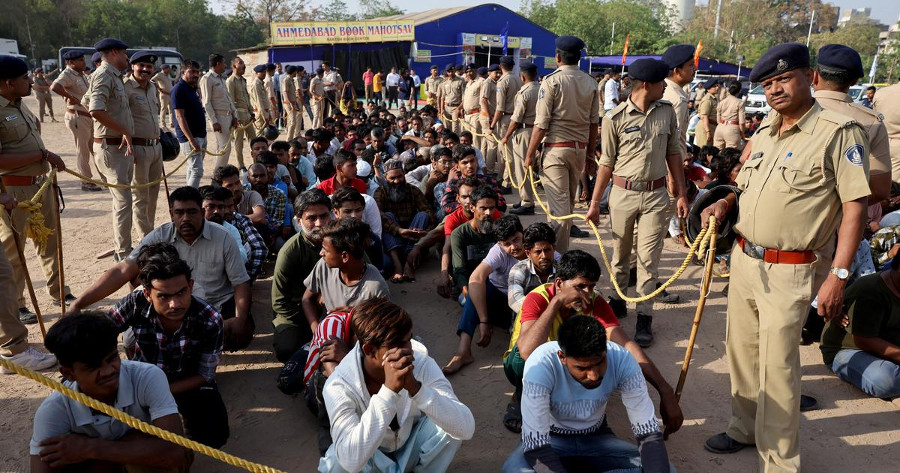
The Indian state has made Bengali Muslims outsiders in their own land In July, a Muslim woman tracing her roots to North 24 Parganas district of West Bengal was detained and deported to Bangladesh in July. These three episodes are a continuation of a phenomenon that began last summer, when the authorities detained thousands of Bengali Muslim workers across the country, deporting hundreds to Bangladesh – mostly without trial or due process. While some of those deported were indeed irregular migrants from Bangladesh living and working in India, many were Bengali-speaking Muslim Indian citizens who had migrated to other parts of the country for work. Several of those deported had to be readmitted to India later. From media stories about those arrested, and deported, two distinct patterns emerge clearly. First, the state’s suspicion is rooted in a combination of ethnicity, language and religion. Scrutiny is triggered primarily by the individual’s identity markers, and documentary checks come only later. Second, the documents presented to support rightful claims of belonging hold little weight. Though families submit many documents relating, for example, to schooling, land ownership and enrollment in the electoral rolls, officials often disregard them and proceed with arrests and deportations. This suspicion reveals narrow and ill-informed ideas about linguistic and ethnic diversity in India, wedded to majoritarian ideas about who belongs – and who does not. This kind of profiling, in which bias about identity comes first and bureaucratic verification comes later, ignores the fact that India is composed of a vast array of ethnic, religious, and linguistic communities. The Bengali-speaking Muslim identity exists on both sides of the border but in India, state functionaries seem to be automatically treating members of this community as unauthorised migrants. To be sure, nation-states have the prerogative to address unauthorised migration within their territory. But it is deeply problematic when they cannot do so without jeopardising their own citizens. As political scientist Niraja Jayal Gopal wrote in the context of the Assam National Register of Citizens, “With what justification can a state that does not have the ability to ‘detect’ aliens, or even to secure its borders against illegal immigrants, set out to find aliens by elimination? This is tantamount not only to using an elephant to crush an ant, but of torturing the elephant to do it.” Many of these cases are examples of the contradiction that legal scholar Mohsin Bhat calls “documentary doublethink”. On the one hand, officials cast acute suspicion on the documents submitted as proof of citizenship, treating them as compromised. At the same time, they affirm the authority of documentation itself by demanding more and more documents, which can be difficult for individuals and families to produce. Moreover, even when valid documents are presented, minor discrepancies in the spelling of names can render them ineffective. It is pertinent to consider certain cases in which people deported to Bangladesh were accepted back into India, often under court directions. Among them were Sunali Khatun and Sweety Bibi: Bengali Muslims from West Bengal who were forcibly pushed into Bangladesh and then accepted back into India after Supreme Court direction. Mumtaz Begum, a Bengali Muslim woman from Assam remains in Bangladesh, even though the Gauhati High Court has asked the state government to pay Rs 2 lakh in compensation for her expulsion and the central government to facilitate her return Alongside these instances of legal intervention, there have been several episodes in both West Bengal and Assam in which people pushed into Bangladeshi territory were subsequently repatriated to India following negotiations between border officials of the two countries and, perhaps, political intervention. What do such cases say about the nature of the state that deports its own citizens in inhumane ways, without following due process or completing necessary checks – only to accept them back? How are we to understand the policies of a state that forcibly pushes some of its own – incriminated by their identity and their documents rendered meaningless – beyond its borders, leaving them to languish in no man’s land or face arrest and detention in foreign jails? Pushing the marginalised towards statelessness upends the very premise of equal citizenship guaranteed in the Constitution. History is witness to what dehumanising, barbaric outcomes such racial and ethnic exclusion can lead to. Abhishek Saha is doing his DPhil at the University of Oxford. He is the author of No Land’s People: The Untold Story of Assam’s NRC Crisis. https://scroll.in/article/1096074/the-indian-state-has-made-bengali-muslims-outsiders-in-their-own-land Back |
 |
||||||
|
|||||||